
Post: Battery Energy Storage System vs Diesel Generator: Which Is Better?
Post Categories
- Battries
- Battery Energy Storage System
- BESS
- Best Inverter Battery for Home
- Cells
- DMEGC Cells
- E - Rickshaw Battery
- Electric Vehicle Battery Manufacturers
- Energy Storage Solutions
- EV Battery
- EV Battery Manufacturers in India
- High Voltage ESS Battery Manufacturer
- Highpower Prismatic Cells
- Highstar Prismatic Cells
- Inverter Lithium Batteries
- Lithium Batteries
- Lithium Battery Manufacturers in India
- Lithium Cells
- Low Voltage ESS Battery Packs
- Manufacturing
- News
- Smart BMS
- Uncategorized
Recent Posts
Questions Every Buyer Should Ask Before Purchasing an ESS
September 22, 2026
No Comments
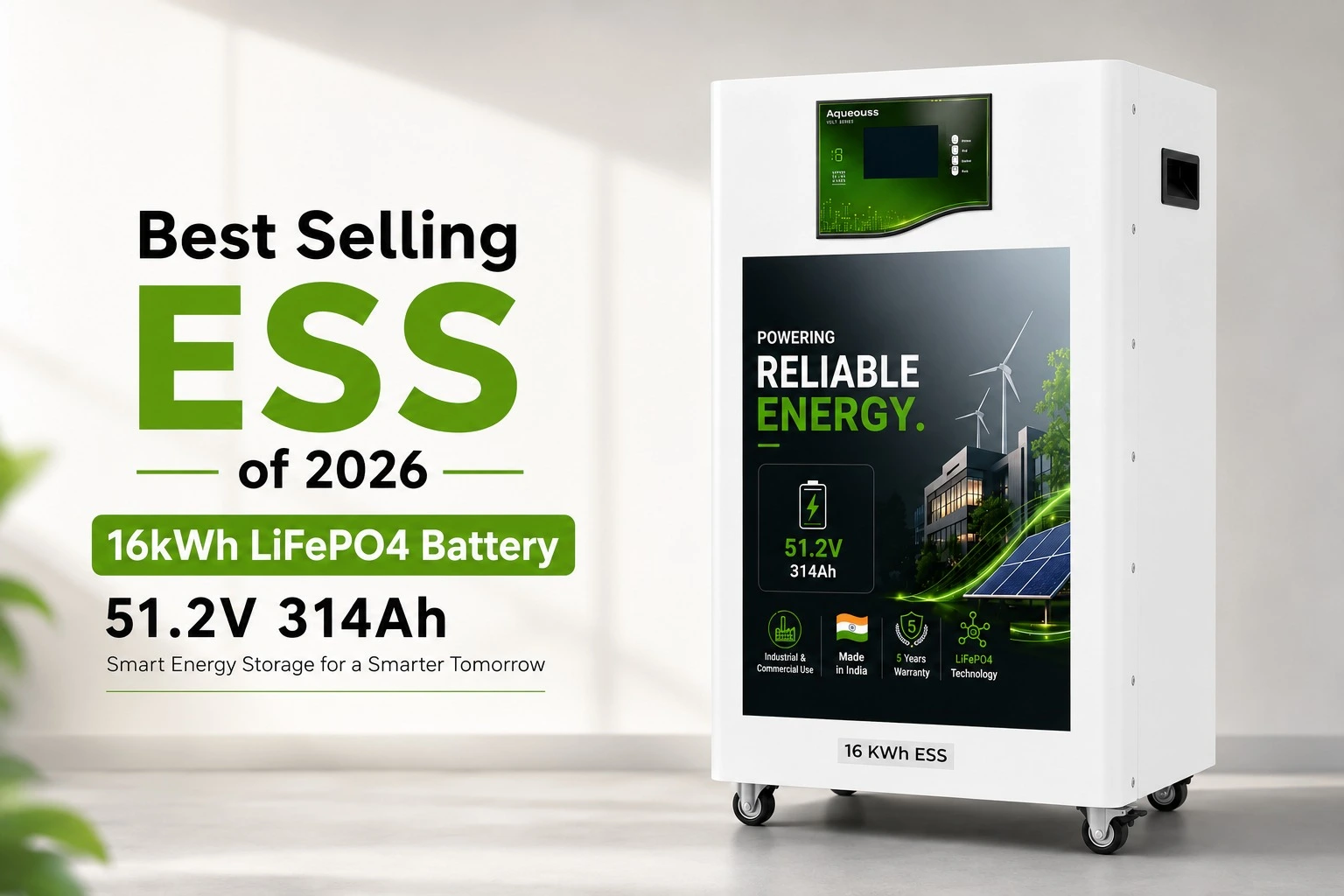
Best Selling ESS of 2026 – 16kWh 51.2V 314Ah LiFePO4 Battery
July 22, 2026
No Comments
Battery Energy Storage System vs Diesel Generator: Which Is Better?
- Admin
- July 11, 2026
- 11:57 am
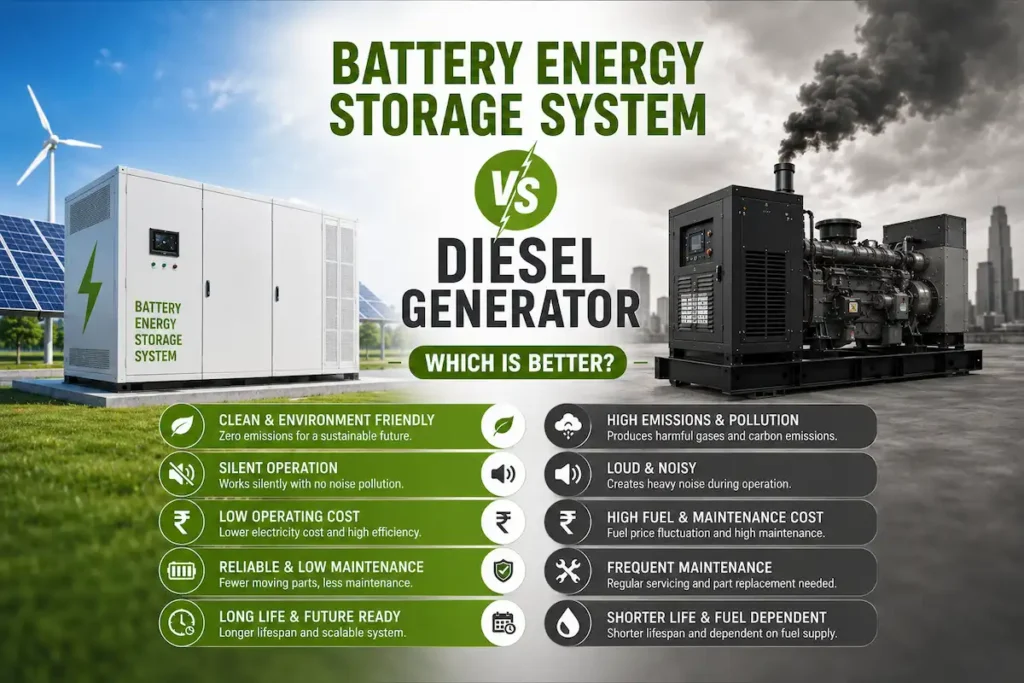
If you’re planning a backup power solution, you’ve probably narrowed your choices to two options: a Battery Energy Storage System (BESS) or a diesel generator.
One promises silent, clean operation, while the other has been the traditional backup choice for decades. So, which one makes more sense today?
The answer depends on your energy needs, but here’s a practical comparison to help you decide.
| Feature | Battery Energy Storage System (ESS) | Diesel Generator |
|---|---|---|
| Backup Start Time | Instant or near-instant power | Typically starts in a few seconds |
| Running Cost | Very low, no fuel required | Continuous diesel fuel expense |
| Maintenance | Minimal maintenance | Regular servicing, oil & filter changes |
| Noise | Silent operation | Loud during operation |
| Emissions | Zero local emissions | Produces smoke and exhaust gases |
| Solar Compatibility | Stores excess solar energy | Cannot store solar power |
| Fuel Dependency | No fuel required | Depends on diesel availability |
| Best For | Homes, offices, shops, hospitals, factories | Long-duration backup where fuel is available |
Which Costs Less Over Time?
At first glance, a diesel generator often costs less to buy.
Many buyers assume that’s the cheaper option.
The reality is different. Diesel generators require fuel, regular servicing, and ongoing maintenance. An Energy Storage System has a higher initial investment but much lower operating costs, especially when combined with rooftop solar.
What Happens During Fuel Supply Disruptions?
This is a question many businesses never consider.
Recent geopolitical tensions around the Strait of Hormuz reminded the world how quickly fuel prices and diesel availability can become uncertain. A diesel generator is only useful if fuel is available.
An ESS Battery, once charged, doesn’t depend on daily fuel deliveries. When paired with solar panels, it can continue supplying backup power while reducing dependence on volatile fuel markets.
Which Is Better for Businesses?
For businesses where even a few seconds of downtime matter, an ESS offers clear advantages. It provides instant backup for computers, servers, security systems, medical equipment, and production machinery.
However, locations that experience outages lasting many hours may benefit from a hybrid solution, where an ESS provides immediate backup and a generator supports extended runtime.
Where Is BESS Replacing Diesel Generators?
The adoption of Battery Energy Storage Systems (BESS) is growing rapidly across homes, businesses, and industries. Today, ESS solutions are available from 5kWh for residential use to 10kWh, 16kWh, 24kWh, 38.4kWh, 50kWh, 100kWh, and even larger systems for commercial and industrial applications.
Small homes often choose a 5kWh ESS, while larger homes are increasingly installing 10kWh or 16kWh ESS (51.2V 314Ah) for longer backup and better solar utilization. Commercial users—including banks, offices, hospitals, hotels, retail stores, warehouses, telecom sites, and manufacturing facilities—are also evaluating BESS to reduce their reliance on diesel generators. Depending on the application, systems like 24kWh ESS (240V 100Ah) and 38.4kWh ESS (384V 100Ah) are becoming popular choices for delivering instant backup, reducing fuel costs, and lowering maintenance.
Rather than replacing diesel generators in every situation, many organizations are adopting a hybrid approach, where the ESS handles everyday outages and the generator is used only during extended power failures. This provides better energy reliability while significantly reducing diesel consumption and operating costs.
Final Thoughts
Neither option is perfect for every situation.
If your priorities are instant backup, quiet operation, lower maintenance, solar integration, and long-term savings, a Battery Energy Storage System is often the smarter investment.
If you regularly experience extended outages and have reliable access to diesel fuel, a generator can still be useful—especially as part of a hybrid backup system.
The best choice isn’t simply the cheapest or the most powerful. It’s the one that matches your energy requirements, budget, future plans, and desired level of energy independence.