

Post: Best Inverter Batteries for Home in 2026 – Expert Picks
Post Categories
- Battries
- Battery Energy Storage System
- BESS
- Best Inverter Battery for Home
- Cells
- DMEGC Cells
- E - Rickshaw Battery
- Electric Vehicle Battery Manufacturers
- Energy Storage Solutions
- EV Battery
- EV Battery Manufacturers in India
- High Voltage ESS Battery Manufacturer
- Highpower Prismatic Cells
- Highstar Prismatic Cells
- Inverter Lithium Batteries
- Lithium Batteries
- Lithium Battery Manufacturers in India
- Lithium Cells
- Low Voltage ESS Battery Packs
- Manufacturing
- News
- Smart BMS
- Uncategorized
Recent Posts

Questions Every Buyer Should Ask Before Purchasing an ESS
September 22, 2026
No Comments
Best Selling ESS of 2026 – 16kWh 51.2V 314Ah LiFePO4 Battery
July 22, 2026
No Comments
Best Inverter Batteries for Home in 2026 – Expert Picks
- Admin
- September 22, 2026
- 7:49 am
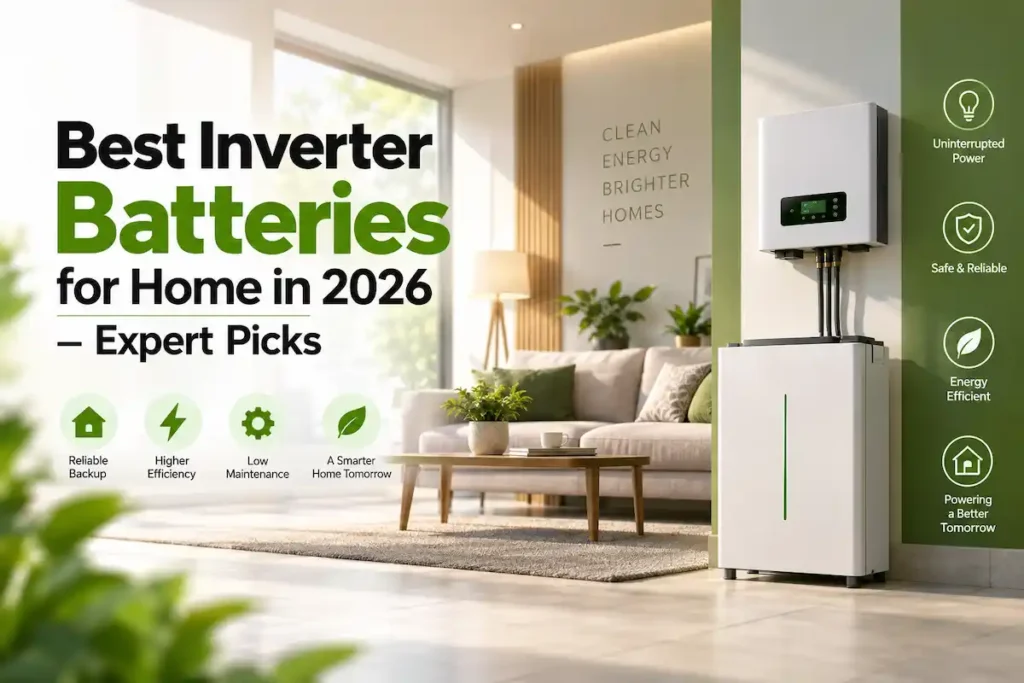
Buying an inverter battery in 2026 is no longer just about choosing between different Ah ratings. Homeowners now have more choices, especially with LiFePO4 lithium batteries becoming a practical alternative to traditional tubular batteries.
The right battery depends on your home’s load, backup requirement, budget, available space and the inverter you already have.
Here are some inverter battery options worth considering in 2026.
What Should You Check Before Buying?
Before buying a battery, don’t look only at the price or Ah rating. Check:
- Battery technology: Lithium or lead-acid
- Usable energy: How much power the battery can actually provide
- Backup requirement: What appliances you need during a power cut
- Charging time: Important if outages happen frequently
- Maintenance: Whether regular water topping-up is required
- Warranty and service: Check the actual terms before buying
- Inverter compatibility: Especially important when switching to lithium
Top Inverter Batteries for Home in 2026
1. Aqueouss – 5kWh Wall Mounted LiFePO4 Battery (51.2V 100Ah)
For homeowners looking for a larger home backup or solar energy-storage system, this is the Aqueouss option to look at.
The 5kWh Wall Mounted LiFePO4 Battery provides around 5.1kWh of nominal energy and comes in a wall-mounted design. It uses LiFePO4 technology and supports CAN and RS485 communication for compatible systems.
With its higher capacity and compact wall-mounted format, it is more suitable for homes with larger backup requirements than a conventional 12V battery.
Best for: Larger homes, solar backup and higher power requirements.
2. Aqueouss – 12.8V 100Ah LiFePO4 Battery
Not everyone needs a 5kWh battery.
For basic home backup, the 12.8V 100Ah Aqueouss lithium battery offers around 1.28kWh of nominal energy in a smaller package. It is a more accessible way to move from traditional lead-acid to lithium, provided your inverter is compatible.
Best for: Apartments, smaller homes and essential backup loads.
3. Luminous Helios 12.8V 100Ah Lithium Battery
Luminous has also expanded its lithium range with the Helios 12.8V 100Ah, offering 1.28kWh energy, up to 3,000 cycles and a 60-month warranty.
Best for: Homeowners looking for a branded lithium alternative for smaller backup requirements.
4. Livguard Lithium X / XDT
Livguard’s lithium range is aimed at homeowners who want faster charging, zero maintenance and smart monitoring. Its Lithium X range includes integrated inverter-and-lithium solutions, while the XDT uses a 12.8V 100Ah battery with Smart BMS and app-based monitoring.
Best for: Modern homes where convenience and smart monitoring matter.
5. Exide EL Ultra – For Traditional Tubular Backup
Lithium isn’t the only option. Many Indian homes still prefer tubular batteries because of their familiar technology and lower initial cost.
Exide’s current EL Ultra range offers tubular batteries with a 72-month warranty, while its InvaTubular range carries a 66-month warranty.
Best for: Buyers who prefer a conventional lead-acid inverter setup.
Lithium or Tubular: What Should You Buy?
If your priority is lower upfront cost, a tubular battery can still make sense.
If you want low maintenance, faster charging, compact installation and longer cycle life, LiFePO4 is worth considering.
The important thing is to match the battery to your actual load instead of simply buying the biggest capacity available.
Final Word
There isn’t one inverter battery that is right for every home.
For smaller backup requirements, a 12.8V 100Ah lithium battery can be enough. For larger loads and solar storage, a 51.2V 100Ah – 5kWh Wall Mounted system can offer considerably more energy.
Before buying, calculate your load, backup hours and inverter compatibility—and then choose the battery that fits your actual usage.
Not sure which battery or inverter capacity is suitable for your requirements? use our Electricity Load Calculator, Inverter Size Calculator, and Backup Time Calculator.