
Post: Energy Storage System Size Calculator: Find the Right ESS Capacity
Post Categories
- Battries
- Battery Energy Storage System
- BESS
- Best Inverter Battery for Home
- Cells
- DMEGC Cells
- E - Rickshaw Battery
- Electric Vehicle Battery Manufacturers
- Energy Storage Solutions
- EV Battery
- EV Battery Manufacturers in India
- High Voltage ESS Battery Manufacturer
- Highpower Prismatic Cells
- Highstar Prismatic Cells
- Inverter Lithium Batteries
- Lithium Batteries
- Lithium Battery Manufacturers in India
- Lithium Cells
- Low Voltage ESS Battery Packs
- Manufacturing
- News
- Smart BMS
- Uncategorized
Recent Posts
Energy Storage System Size Calculator: Find the Right ESS Capacity
Why E-Rickshaw Controllers Fail—And How to Prevent It?
The Hidden Chemistry Battle: LFP vs NMC Batteries for E-Rickshaws
Energy Storage System Size Calculator: Find the Right ESS Capacity
- Sarvesh Maurya
- March 9, 2026
- 11:44 am
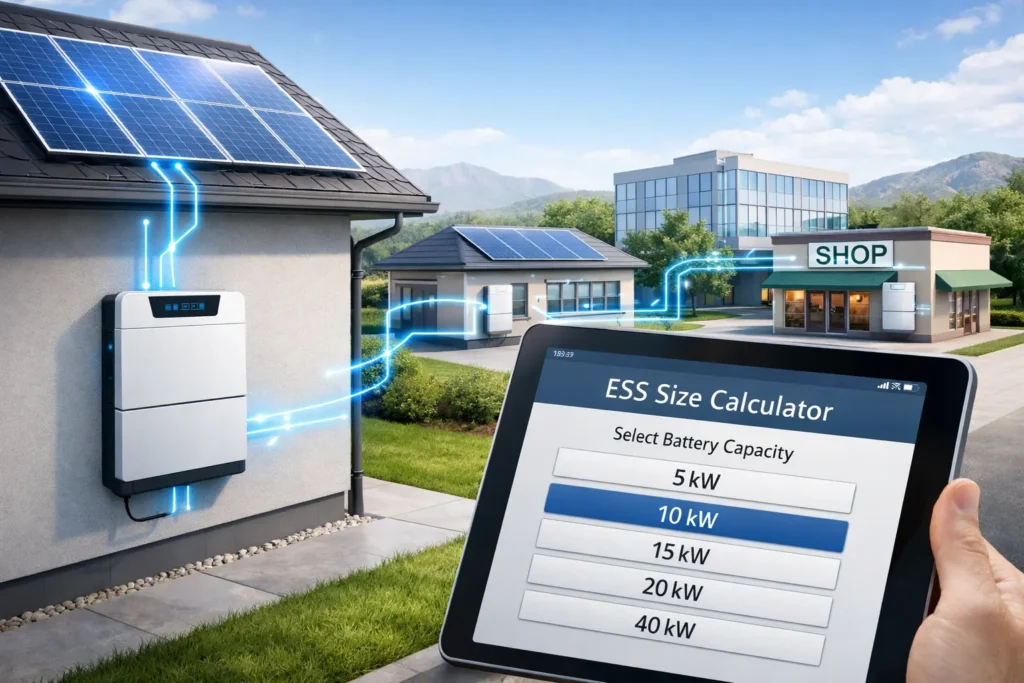
If you’re planning to install a solar power system or looking for a reliable power backup solution, one question almost always comes up first:
“What size Energy Storage System do I actually need?”
It’s a fair question. Many homeowners, shop owners, and even businesses install an Energy Storage System (ESS) without fully understanding the required capacity. Sometimes the system ends up being too small, which means it cannot provide backup for long enough. Other times it’s oversized, which simply increases the investment without real benefits.
In simple terms, choosing the right ESS capacity is about balancing power needs, backup time, and budget.
This is where an ESS size calculator or a simple estimation method becomes very useful. Once you understand how energy consumption works, estimating the right system size becomes much easier.
Let’s break it down step by step.
What is an Energy Storage System (ESS)?
An Energy Storage System (ESS) is a system that stores electricity so it can be used later when needed.
Most modern ESS setups store electricity using lithium batteries, which are efficient, long-lasting, and compact.
These systems usually work in combination with:
- Solar panels
- Electric grid power
- Hybrid inverters
Here’s how it works in simple terms.
During the day, solar panels generate electricity. If that electricity isn’t immediately used, the lithium energy storage system stores the extra energy in batteries.
Later, when the power goes out or electricity demand increases, the stored energy is used to power your home or building.
This is why ESS systems are becoming increasingly popular for:
- Homes with solar installations
- Shops and retail stores
- Offices and clinics
- Factories and commercial buildings
They provide backup power, energy savings, and energy independence.
Understanding ESS Capacity (kW vs kWh)
When discussing ESS systems, two technical terms often appear: kW and kWh. Many people confuse the two.
Let’s simplify it.
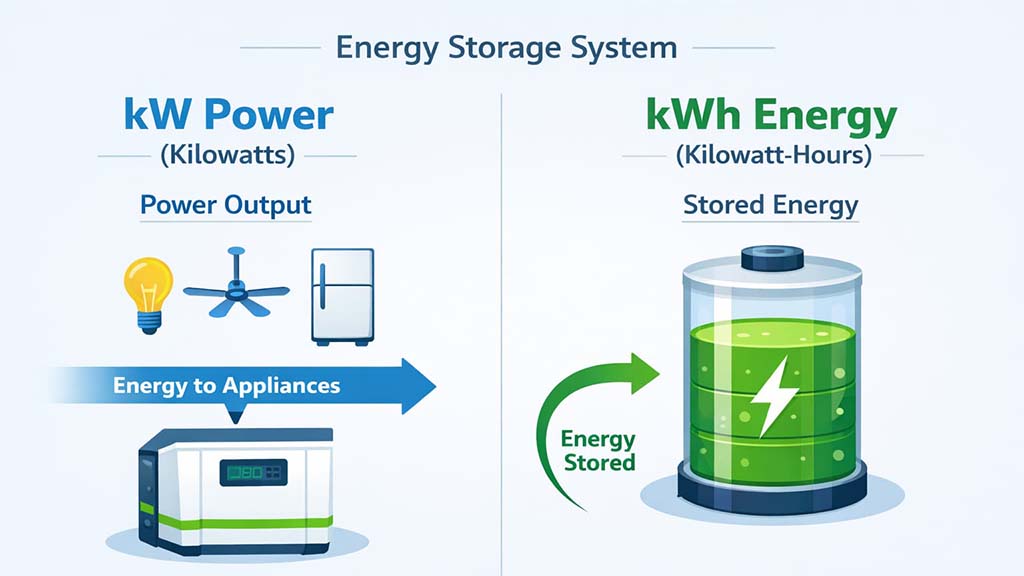
kW (Kilowatt)
kW refers to the power output capacity of the system.
It indicates how many appliances the system can run at the same time.
For example:
A 5kW ESS system can typically support loads like lights, fans, TV, refrigerator, and some small appliances simultaneously.
kWh (Kilowatt-hour)
kWh refers to the total stored energy in the batteries.
It determines how long the backup will last.
Think of it like a water tank:
-
kW = how fast water flows from the tap
-
kWh = how much water the tank stores
So even if you have a powerful system, if the battery storage is small, the backup time will be limited.
Simple Method to Estimate ESS Size
If you’re wondering how to calculate ESS capacity, there’s a simple method professionals often use.
Step 1: List the appliances that need backup
Start by listing the devices you want to run during a power outage.
For example:
- Lights
- Ceiling fans
- Refrigerator
- Wi-Fi router
- Television
- Laptop or computer
Step 2: Estimate total power consumption
Let’s say the approximate power usage looks like this:
- Lights: 200W
- Fans: 300W
- Refrigerator: 300W
- TV: 150W
- Router: 20W
Total load ≈ 970W (about 1kW)
Step 3: Decide the backup duration
Now decide how long you want the system to run during a power outage.
Let’s say you want 5 hours of backup.
Step 4: Calculate required battery capacity
Now multiply:
Power load × Backup hours
1kW × 5 hours = 5 kWh battery capacity
So in this case, a 5kW residential ESS system would typically be suitable.
This kind of simple estimation is essentially what an ESS size calculator does.
ESS Size Guide for Different Applications
The ideal ESS capacity depends on where it will be used. Let’s look at some common scenarios.
Residential ESS Systems
Most homes typically install ESS systems between 5kW and 15kW.
Suitable for:
- Small homes or apartments
- Basic loads like lights, fans, TV, router
For example, a family that mainly needs backup during short power cuts.
Ideal for:
- Medium-sized homes
- Refrigerator, washing machine, multiple rooms
This setup provides more flexibility and longer backup time.
Often chosen for:
- Larger houses
- Homes with multiple appliances running simultaneously
Suitable for:
- Villas or large houses
- Homes running air conditioners or higher loads
This type of residential ESS system ensures smooth power supply even during longer outages.
Small Commercial ESS Systems
Commercial spaces usually require slightly larger systems.
20kW ESS
Common for:
- Small offices
- Medical clinics
- Retail shops
25kW ESS
Suitable for:
- Medium commercial spaces
- Small manufacturing units
30kW ESS
Often used in:
- Restaurants
- Workshops
- Large office spaces
Ideal for:
- Commercial buildings
- Facilities with higher electrical demand.
These systems help businesses avoid downtime during power interruptions.
Large Scale Energy Storage Systems
Beyond homes and small businesses, ESS technology is also used on a much larger scale.
Commercial ESS systems
Typically range between 100 kWh and 250 kWh.
These are used in:
- Commercial complexes
- Warehouses
- Shopping malls.
Industrial ESS systems
Usually range from 500 kWh to 1 MWh.
Industries install these systems for:
- Peak load management
- Energy cost optimization
- Reliable backup power.
Utility-scale ESS
These are massive installations ranging from 10 MWh to over 100 MWh.
Utility companies use them to:
- Stabilize electrical grids
- Store renewable energy
- Manage peak demand.
Example Battery Configurations
Energy Storage Systems are typically built using lithium battery modules connected together.
Let’s look at a simple example.
5kW ESS using a 51.2V 100Ah lithium battery
Battery energy can be calculated as:
Voltage × Amp-hour
51.2V × 100Ah = 5120Wh
Which is roughly 5.12 kWh of stored energy.
5kW ESS using a 60.8V 100Ah lithium battery
60.8V × 100Ah = 6080Wh
Which equals approximately 6.08 kWh of stored energy.
In simple terms, higher voltage or higher amp-hour batteries store more energy, which increases the backup duration.
This is why different lithium energy storage systems can offer different performance even if their system power rating looks similar.
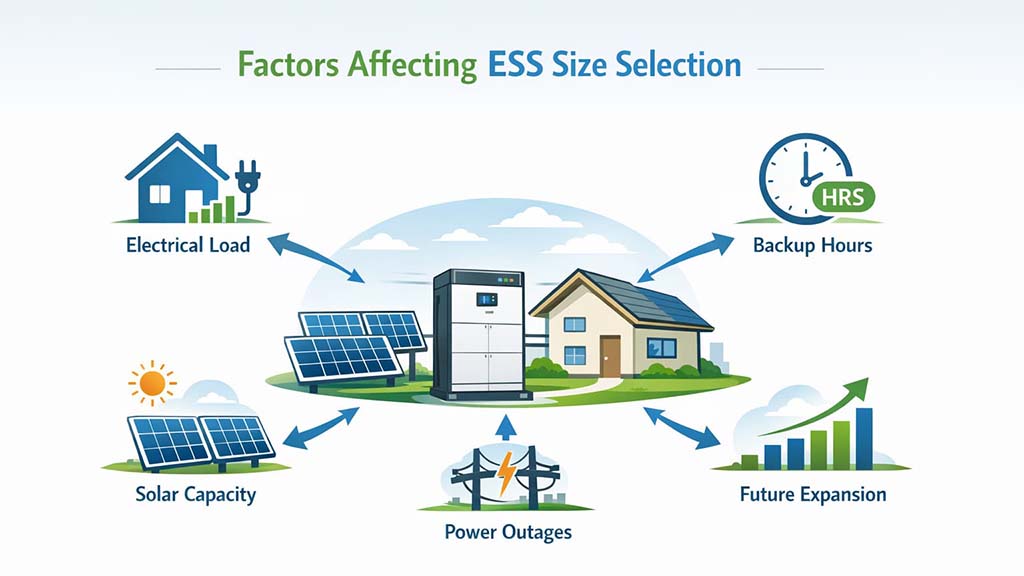
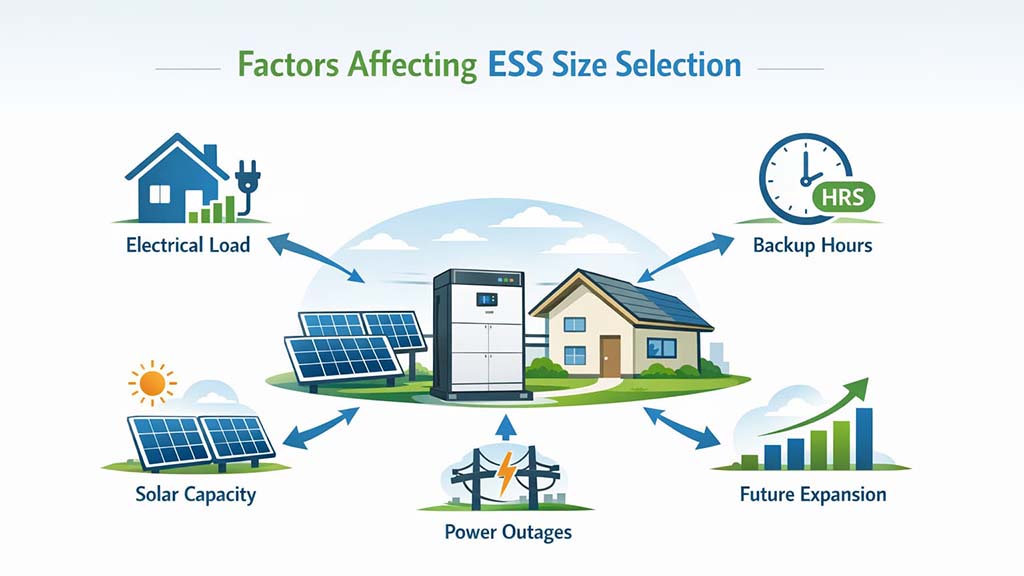
Factors That Affect ESS Size Selection
In real-world installations, several factors influence the correct ESS capacity.
Total electrical load
The more appliances you want to run simultaneously, the higher the system capacity required.
Backup duration
Some people only need 2–3 hours of backup, while others want overnight backup.
Solar panel capacity
If the ESS system is connected to solar panels, the available solar generation also affects battery size.
Frequency of power cuts
In areas with frequent power outages, a larger ESS capacity may be necessary.
Future energy needs
Many homeowners plan for future expansion.
For example, installing:
- additional air conditioners
- EV chargers
- new appliances
Planning ahead avoids system upgrades later.
Conclusion
Choosing the right Energy Storage System capacity is essential for getting the best performance from your backup or solar power system.
A properly sized ESS ensures:
- reliable backup power during outages
- better energy efficiency
- optimized electricity usage
- long-term savings on energy costs.
Whether you’re installing a residential ESS system, a commercial ESS system, or a larger lithium energy storage system, the key is understanding your energy requirements first.
In simple terms, think about how much power you use and how long you need backup. Once those numbers are clear, selecting the right ESS capacity becomes much easier.
And if you’re still unsure, using an ESS size calculator or consulting an energy storage expert can help you make the right decision for your home or business.